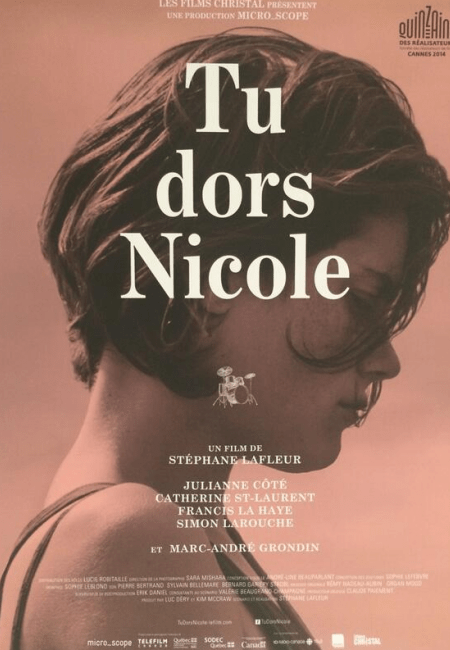
Tu Dors Nicole

  • Year: 2014
  • Country: Canada
  • Director: Stéphane Lafleur
  • Starring: Julianne Côté, Catherine St-Laurent, Marc-André Grondin

A coming of age story about 22 year-old Nicole (Julianne Côté), who is supposed to have her parents’ house by herself while they are on holiday for the summer, and finds that her brother (Marc-André Grondin) has set-up a practice space/studio with his rock band there to record. The film follows the shy and introverted Nicole as she hangs out or wanders around, sometimes with best friend (Catherine St-Laurent), sometimes alone, rather aimlessly. Beautifully shot in black in white (which almost seems to give us the way Nicole sees the world) with shots that are slow and wide: a brilliant tool for this film as no fast editing can create a false sense of pacing. The camera moves very slowly but is mostly static. The film plays through like a quiet breeze, often very funny and always hinting at more pain and desire beneath Nicole’s hushed surface (i.e. some standout scenes involve her awkwardly flirting with the band’s drummer, played by Francis La Haye). Writer/director Stéphane Lafleur has an ear for honest dialogue and comedic situations that brings to mind Noah Baumbach, while Julianne Côté is simply endearing and completely believable as Nicole. A simple, quiet film that finds its strengths in authenticity, intimacy and comedy.

Tenemos La Carne (We Are The Flesh)

  • Year: 2016
  • Country: Mexico
  • Director: Emiliano Rocha Minter
  • Starring: María Evoli, Noé Hernández, Diego Gamaliel

It would appear the cinema of Gaspar Noé has made its influence felt through Mexico! I’ll say this: there’s something in this one to offend or repulse everyone. A brother and sister find an abandoned building in a city of ruins and decide to take shelter. The only problem is a severely deranged man (and I mean severely – what a performance by Diego Gamaliel) occupies the building and in order to stay they have to abide by his rules. What follows is an intense psychedelic trip of a movie – to say not for the faint of heart is an understatement. Newcoming director Emiliano Rocha Minter’s vision mostly works – just a little bit too much Gaspar Noé-like at times – but for a first time director, making such an intense, creative and twisted work is no small feat. See it if you can stomach it; you’ve been warned. I’ll leave you with the trailer: https://www.youtube.com/watch?v=otYBglOyHtw

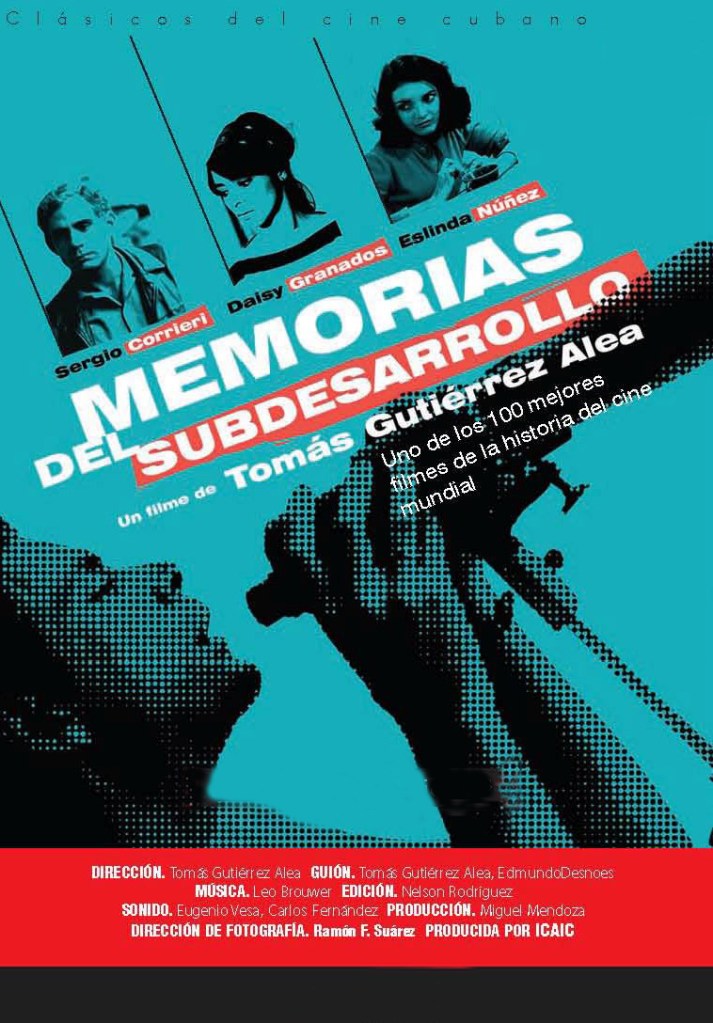
Memorias Del Subdesarrollo (Memories Of Underdevelopment)

  • Year: 1968
  • Country: Cuba
  • Director: Tomás Gutiérrez Alea
  • Starring: Sergio Corrieri, Daisy Granados

The 3rd and final planned film by Gutiérrez Alea I was to watch this month is by far the best. Taking place in 1961 after the Bay of Pigs invasion, a man in his late thirties wanders around Havana rather aimlessly, trying to find meaning in his life and how it relates to the newly liberated Cuba and trying to find comfort in the arms of strangers, never fully approving of those he meets. Through his own narration we are led into the mind of a man who understands what is happening around him but is unable to be the change he wants to see in life; the change he expects to see from his fellow people. His hypocrisy through inaction lead his choices. Through intricate voice-over narration and spliced in news footage, we see both an objective and subjective view of the Cuban revolution. A film that calls everything into question that was controversial for its subject matter when it came out – many didn’t know what to make of the film’s “opinion” about the revolution. The film takes visual elements of the French New Wave but creates its own identity altogether. Gutiérrez Alea in 1974 won the award of the National Society of Film Critics in New York but was denied entry to the U.S. to accept the award.

Requiem Pour Un Vampire

  • Year: 1971
  • Country: France
  • Director: Jean Rollin
  • Starring: Marie-Pierre Castel, Mireille Dargent

Two girls on the run from…something (does it really matter?) find a castle in the middle of the countryside and decide to hide there and of course, immediately get naked and cuddle. They soon find out it is a vampires’ castle, and the vampires need virgin blood in order to pass their curse. They also keep their victims in chains, and well, you can imagine the rest. So this was my first Jean Rollin film, and apparently it was his own favourite. He wrote it in two days “from his subconscious” which likely accounts for the minimal dialogue and its mood-over-story emphasis. The actors seem to be unable to convey any emotion or were instructed to not even try. Somehow, it all doesn’t matter because you know it’s not meant to be The Exorcist and it’s kinda camp fun anyway. I’d probably watch more Rollin if I could find some. You’re probably meant to take this film seriously, but it’s a whole lot more fun if you don’t.

Zirneklis (Spider)

  • Year: 1992
  • Country: Latvia
  • Director: Vasili Mass
  • Starring: Aurelija Anuzhite, Liubomiras Laucevicius

I genuinely did not understand anything in this movie, so I’m going to steal the storyline from imdb.com: Nubile shut-in agrees to model for a strange artist as Virgin Mary. His sinister influence corrupts her repressed sexual urges causing her to have delusions and nightmares about a giant spider raping her. A priest tries to save her. So that’s apparently what the story is. There’s a dream sequence where the main character has sex with a giant spider. I’m sure that has to count for something in film history! I really don’t have much more to say. Not very good but then again, with this story line what the hell was I expecting?

Roads

  • Year: 2019
  • Country: Germany/France
  • Director: Sebastian Schipper
  • Starring: Fionn Whitehead, Stéphane Bak

Gyllen, a British 18 year old vacationing with his mother and stepdad in Morocco, steals their RV and decides to go visit his father in France. Along the way he meets William, 17 years old, from Congo, who is hitchhiking his way to France in order to find his missing brother, a refugee. The two strike up a friendship and what starts out as a road movie about two boys growing up and seeing the world eventually becomes an exploration of identity and an almost documentary-like 3rd act showing a very real refugee crisis. Stéphane Bak, as William, deserves special mention for his portrayal of a boy coming of age, completely determined and never losing focus. A very talented actor. Nevermind the 6.0 rating on imdb, it’s filled with people venting out their political frustrations on the refugee crisis giving the film 1.0. Unfortunately, the internet. Worth seeing.

A Vida Invisível (Invisible Life)

  • Year: 2019
  • Country: Brazil
  • Director: Karim Aïnouz
  • Starring: Carol Duarte, Julia Stockler

Advertised as a “Tropical Melodrama”, Invisible Life does take place in 1950’s Rio De Janeiro but is much more than the tagline suggests. It’s the tale of two sisters who each mistakenly believe that the other is living a dream life on the other side of the world – we follow each of their lives, individually, as the two of them long for one another and try to find their place. It’s the stuff that great films are built upon: poetic and full of big, important ideas; with cinematography and music that puts you at that time and place; an inventive narrative and characters which are completely believable. There’s been a bit of controversy about this one due to the graphic sexual nature of a particular scene, but this type of controversy ultimately cheapens the film: it’s a powerful and insightful exploration of womanhood and the almost superhuman strength one needs to keep living with their head up, even when life never goes as planned and your dreams always seem a bit further away. Sadly, the film falls under its own awesome weight in the final act, giving us an unsatisfying/unrealistic conclusion (which to be fair may have been already the case in the novel by Martha Batalha which this was based on). Nevertheless, its strengths more than make up for its few faults and it is certainly head and shoulders above Aïnouz’s other film I saw this week, Madame Satã. Watch Invisible Life’s trailer here.

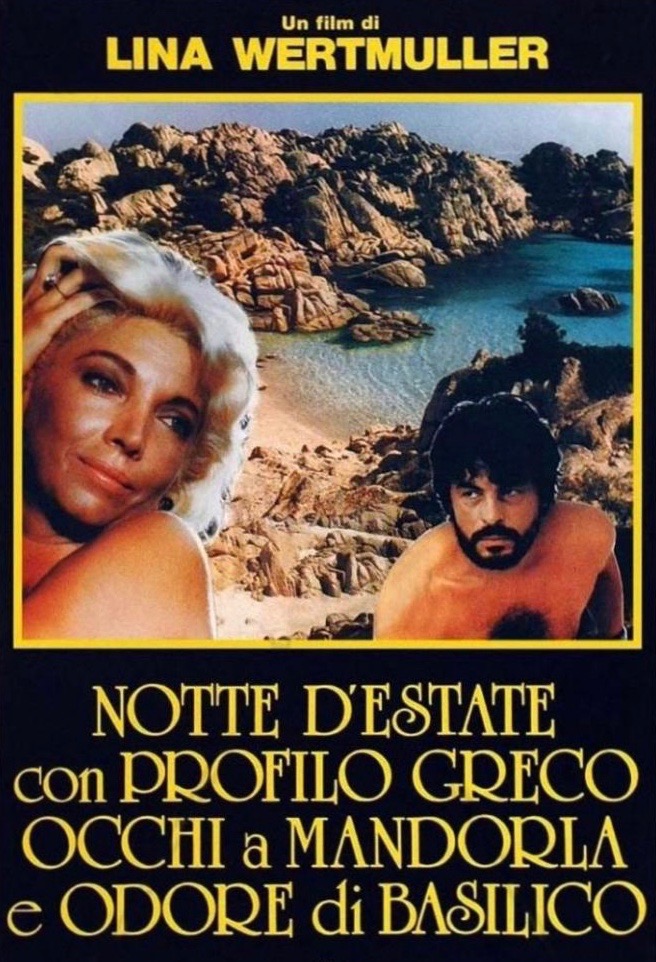
Notte D’estate Con Profilo Greco, Occhi a Mandorla e Odore di Basilico (Summer Night with Greek Profile, Almond Eyes and Scent of Basil)

  • Year: 1986
  • Country: Italy
  • Director: Lina Wertmüller
  • Starring: Mariangela Melato, Michele Placido

Let’s just call the movie like the DVD box says: Summer Night. Shall we? The title is probably the most inventive thing about this incredibly forgettable film, a pale copy of Wertmüller’s own and far superior “Swept Away” (the original from 1974 – not the Madonna remake!). A rich industrial (Melato) kidnaps a bandit (Placido) as revenge for all the people he had kidnapped from her organization and held for ransom. The film takes place in her luxurious villa in Sardinia, and at a certain point Placido decides that if he is to be kidnapped, he cannot go on without sex, which unleashes Melato’s own desires. The comedy falls flat, the film is completely predictable, its only saving grace being Sardinia itself – a magnificent shooting location that makes the film, at the very least, watchable. Stick to the original “Swept Away”.

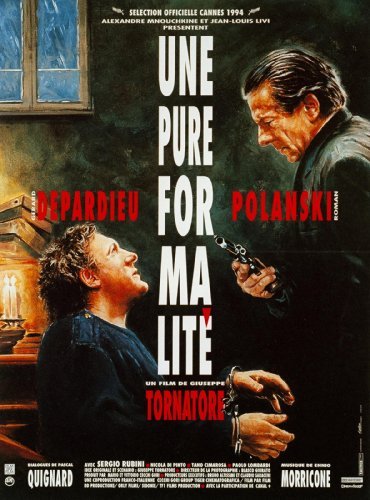
Una Pura Formalità (A Pure Formality)

  • Year: 1994
  • Country: Italy/France
  • Director: Giuseppe Tornatore
  • Starring: Gérard Depardieu, Roman Polanski

If any director can be credited to opening me up to “World” cinema, it’s Giuseppe Tornatore. Watching “Cinema Paradiso” as a teenager did change how I saw movies, and what a film could make you feel. I’ve seen almost all of his films, and this one I’d been trying to find a good copy for many years. Nominated for 1994’s Palme D’or at Cannes, it tells, on the surface, what should be a simple story of a man (Dépardieu) brought in for questioning by the police as he is walking alone seemingly lost one stormy night. We do not know what crime he may or may not be accused of, and the Commissioner questioning him (Polanski) appears to know much more than he is letting on. The fun here is that the film pretty much all takes place inside the old, decrepit police station. You can forgive an action movie for having bad dialogue if the action scenes make up for it; a horror movie for the gaps in logic if it gave you a good scare, etc… but for a film to take place solely in one main location, there can be no weak link. And this is where the film works: intelligent story/script, creative camera angles, clever editing (by Tornatore, who took on the dual role of director and editor), a killer score by Ennio Morricone, and two insanely great performances by Dépardieu and Polanski, who go deep but also seem to have a lot of fun. I won’t go much more into the story line only to say this is one that will take you to unexpected places and a film that deserves to be seen a 2nd time. Try to go along for the ride and not jump to conclusions.

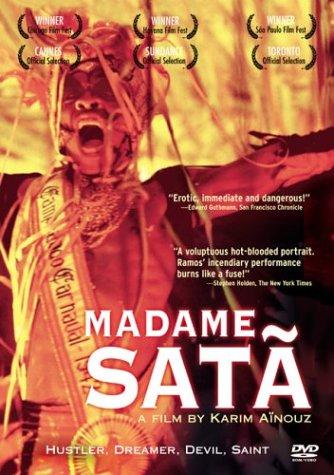
Madame Satã

  • Year: 2002
  • Country: Brazil
  • Director: Karim Aïnouz
  • Starring: Lázaro Ramos, Marcelia Cartaxo, Flavio Bauraqui

Rather disappointing biopic of João Francisco dos Santos, aka Madame Satã, a transvestite, performer, thief and later convicted murderer from Rio De Janeiro. The film takes place in 1932, about 10 years before dos Santos’ mythical Madame Satã persona was created and focuses on his struggles living in the slums of Rio along with prostitutes, hustlers and his relationship with his on/off lover Renatinho. Unfortunately, the film does little in giving us any type of context for the time and place, or the main character’s back story. Sure, the film itself gives us the needed backstory for the creation of Madame Satã – but if you don’t know anything about Madame Satã, the film just gives you the portrait of a very angry yet passionate person who, you are told, later becomes important. We are left caring very little about what goes on, instead focusing on atmosphere, decor and an astonishing performance by Lázaro Ramos. You’ll finish the film learning very little and instead going on Wikipedia to fill in the gaps.

Design a site like this with WordPress.com
Get started